

How to get kids
off social media,
according to research
How to get kids
off social media,
according to research
Teens want less social media. They just won't quit alone. Studies and field trials from Chicago to London to Rio de Janeiro show how to change that.
Teens want less social media. They just won't quit alone. Studies and field trials from Chicago to London to Rio de Janeiro show how to change that.
Why do teens spend so much time on social media?
Why do teens spend so much time on social media?
Two forces keep teens scrolling. The apps are built to hold their attention, and everyone they know is on them.
Two forces keep teens scrolling. The apps are built to hold their attention, and everyone they know is on them.
The platforms are designed for it
The platforms are designed for it
Endless feeds, autoplay, and notifications all exist for one purpose: keeping users engaged as long as possible. Every design choice is tested and refined towards that goal.
Endless feeds, autoplay, and notifications all exist for one purpose: keeping users engaged as long as possible. Every design choice is tested and refined towards that goal.
The feed is where their friends are
The feed is where their friends are
Most solutions miss this second force. Social media is social. Plans, group chats, inside jokes, viral moments, and status all run through the feed, so logging off means missing out. A teen who quits alone doesn't just lose an app. They lose their place in the conversation.
Most solutions miss this second force. Social media is social. Plans, group chats, inside jokes, viral moments, and status all run through the feed, so logging off means missing out. A teen who quits alone doesn't just lose an app. They lose their place in the conversation.
Teens want less social media.
They just can't do it solo.
Teens want less social media.
They just can't do it solo.
Built on 15 years of behavioral science, Leonardo Bursztyn's research finds that many young people wish they spent less time scrolling. But nobody wants to be the only one who leaves. That's a collective trap, and getting out of it takes collective action.
Built on 15 years of behavioral science, Leonardo Bursztyn's research finds that many young people wish they spent less time scrolling. But nobody wants to be the only one who leaves. That's a collective trap, and getting out of it takes collective action.
The social media trap
The social media trap
Young people would want to be paid to quit social media alone, but they'd pay to have everyone quit together.
Young people would want to be paid to quit social media alone, but they'd pay to have everyone quit together.
$28
$28
What they'd pay to have their friends quit with them.
What they'd pay to have their friends quit with them.
Why? FOMO.
No one changes a norm alone
No one changes a norm alone
In an incentivized experiment with more than 1,000 U.S. college students, Bursztyn and his co-authors asked what it would take for students to quit TikTok or Instagram for a month. Quitting alone was a cost, and students wanted to be paid to do it. When the question changed to "What if your classmates quit too?", the answer flipped. Many students would pay to make that happen.
In an incentivized experiment with more than 1,000 U.S. college students, Bursztyn and his co-authors asked what it would take for students to quit TikTok or Instagram for a month. Quitting alone was a cost, and students wanted to be paid to do it. When the question changed to "What if your classmates quit too?", the answer flipped. Many students would pay to make that happen.
The reason was fear of missing out. For most users, the platform's value comes from the fact that everyone else is on it. The researchers found that 64% of active TikTok users and 48% of Instagram users felt they would be better off if the platform didn't exist at all.
They stay because leaving alone costs too much. That's the collective trap.
Bursztyn, Handel, Jiménez-Durán & Roth, "When Product Markets Become Collective Traps: The Case of Social Media," American Economic Review. Read the study →
Why social media bans fall short
Why social media bans fall short
Australia's under-16 ban shows why rules alone can't break the trap
Australia's under-16 ban shows why rules alone can't break the trap
When their friends don't comply, teens don't either, and compliance with Australia's ban collapsed within months.
When their friends don't comply, teens don't either, and compliance with Australia's ban collapsed within months.
In December 2025, Australia became the first country to ban under-16s from major social media platforms. Bursztyn and a team that included Angela Duckworth and Cass Sunstein surveyed Australian teens to see what happened.
In December 2025, Australia became the first country to ban under-16s from major social media platforms. Bursztyn and a team that included Angela Duckworth and Cass Sunstein surveyed Australian teens to see what happened.
Four months in, fewer than one in three banned 14 and 15 year olds were complying. Two months after that, compliance had fallen to about one in twenty. Over the same period, the share of banned teens still using social media rose from 64% to 92%.
Four months in, fewer than one in three banned 14 and 15 year olds were complying. Two months after that, compliance had fallen to about one in twenty. Over the same period, the share of banned teens still using social media rose from 64% to 92%.
↑ Share of banned 14–15 year olds in Australia, April vs. June 2026. Source: Bursztyn et al., 2026.
Why the ban failed
Why the ban failed

Social media is social
Social media is social
Most teens who kept using the apps gave social reasons, and most believed their friends were still on them. A ban only works if your peers follow it too.
Most teens who kept using the apps gave social reasons, and most believed their friends were still on them. A ban only works if your peers follow it too.

A tipping point is necessary
A tipping point is necessary
Teens said they'd comply once about two-thirds of their peers did. Compliance never got close, so it unraveled.
Teens said they'd comply once about two-thirds of their peers did. Compliance never got close, so it unraveled.

But it isn't enough
But it isn't enough
Teens who complied were seen as less popular. Until popular, influential kids get off too, leaving looks like losing status.
Teens who complied were seen as less popular. Until popular, influential kids get off too, leaving looks like losing status.
A ban changes the rules. It doesn't change why teens want to be there. That takes a different approach.
A ban changes the rules. It doesn't change why teens want to be there. That takes a different approach.
Bursztyn, Duckworth, Jiménez-Durán, Leonard, Milojević, Roth & Sunstein, "Tipping Points and Australia's Social Media Ban," NBER Working Paper 35162. Read the study →
Australia's own eSafety Commissioner reported 81% of under-16s were still using social media three months after the ban took effect.
Australia's own eSafety Commissioner reported 81% of under-16s were still using social media three months after the ban took effect.
What works to get kids off social media
What works to get kids off social media
To get kids off social media, you have to change what their friends do, not just what they're allowed to do. The research points to three things that get a group to a tipping point: new norms, real incentives, and something better to do with their time.
To get kids off social media, you have to change what their friends do, not just what they're allowed to do. The research points to three things that get a group to a tipping point: new norms, real incentives, and something better to do with their time.
Platform changes and bans deal with the supply side, meaning how the apps function and who's allowed on them and when. They don't touch the demand side: the social pull that makes teens want to be there, and makes them look for a workaround when they aren't allowed.
Platform changes and bans deal with the supply side, meaning how the apps function and who's allowed on them and when. They don't touch the demand side: the social pull that makes teens want to be there, and makes them look for a workaround when they aren't allowed.
Teens log off for good when enough of their friends do too.
Teens log off for good when enough of their friends do too.
Norms
Make logging off the high-status move
Teens follow what the influential kids do, so the goal is to make time off the feed the thing to be seen doing. Autonomy matters too so it has to feel like their choice, not something forced upon them. A similar shift in norms helped drive down youth smoking.
Incentives
Reward people for scrolling less
Leaving a platform alone has a real social cost. Incentives offset it, and they get the first wave of kids moving before the new norm can take hold.
Alternatives
Offer something to do with reclaimed time
Hours taken away from scrolling have to go somewhere. The best alternative is friends, but friends are only available if they aren't scrolling either. That's why reducing screen use one teen at a time doesn’t work.
Put into action together, these principles are effective as a group activity, not as an exercise in personal willpower. That's what NOMO was built for.
Put into action together, these principles are effective as a group activity, not as an exercise in personal willpower. That's what NOMO was built for.
How NOMO puts the research to work
How NOMO puts the research to work
Built by leading behavioral scientists, NOMO is designed to change a collective habit, not just an individual one.
Built by leading behavioral scientists, NOMO is designed to change a collective habit, not just an individual one.

Leonardo Bursztyn
CEO & Founder

Angela Duckworth
Scientific Advisor

Betsy Levy Paluck
Scientific Advisor

Matthew Gentzkow
Scientific Advisor
Leonardo Bursztyn
CEO & Founder
Angela Duckworth
Scientific Advisor
Betsy Levy Paluck
Scientific Advisor
Matthew Gentzkow
Scientific Advisor
NOMO uses the science of collective action and incentives to help people reclaim their time. People give so much of their time to social media because everyone else does, so change has to happen together. NOMO moves whole groups toward a healthier balance with real life, and brand partners reward them for it.
NOMO uses the science of collective action and incentives to help people reclaim their time. People give so much of their time to social media because everyone else does, so change has to happen together. NOMO moves whole groups toward a healthier balance with real life, and brand partners reward them for it.
Collective action
Challenges & Bumps
Challenges & Bumps
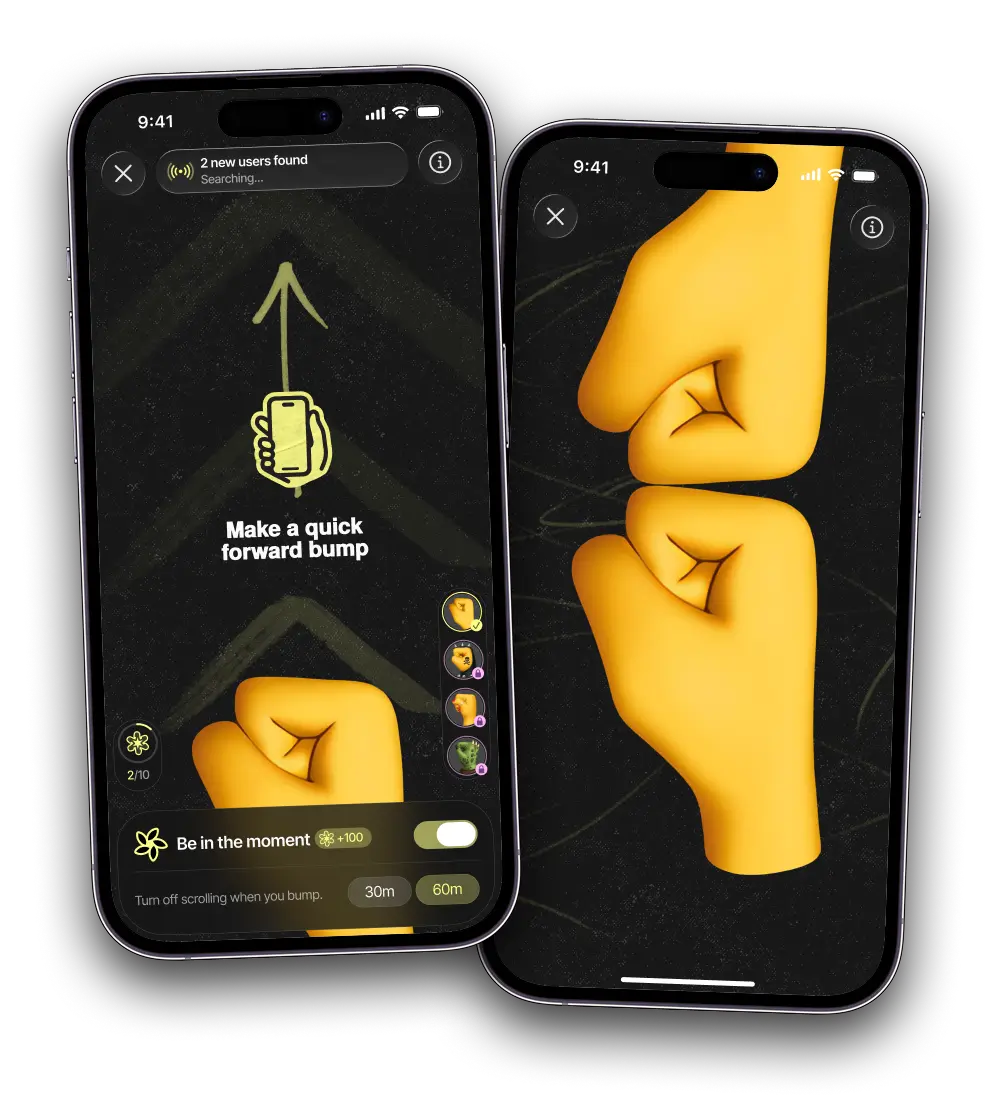
Teens join challenges with friends and bump phones to lock their scrolling apps while together, earning extra Moments when they do. Nobody logs off alone.
Teens join challenges with friends and bump phones to lock their scrolling apps while together, earning extra Moments when they do. Nobody logs off alone.
Norms
Leaderboard
Leaderboard
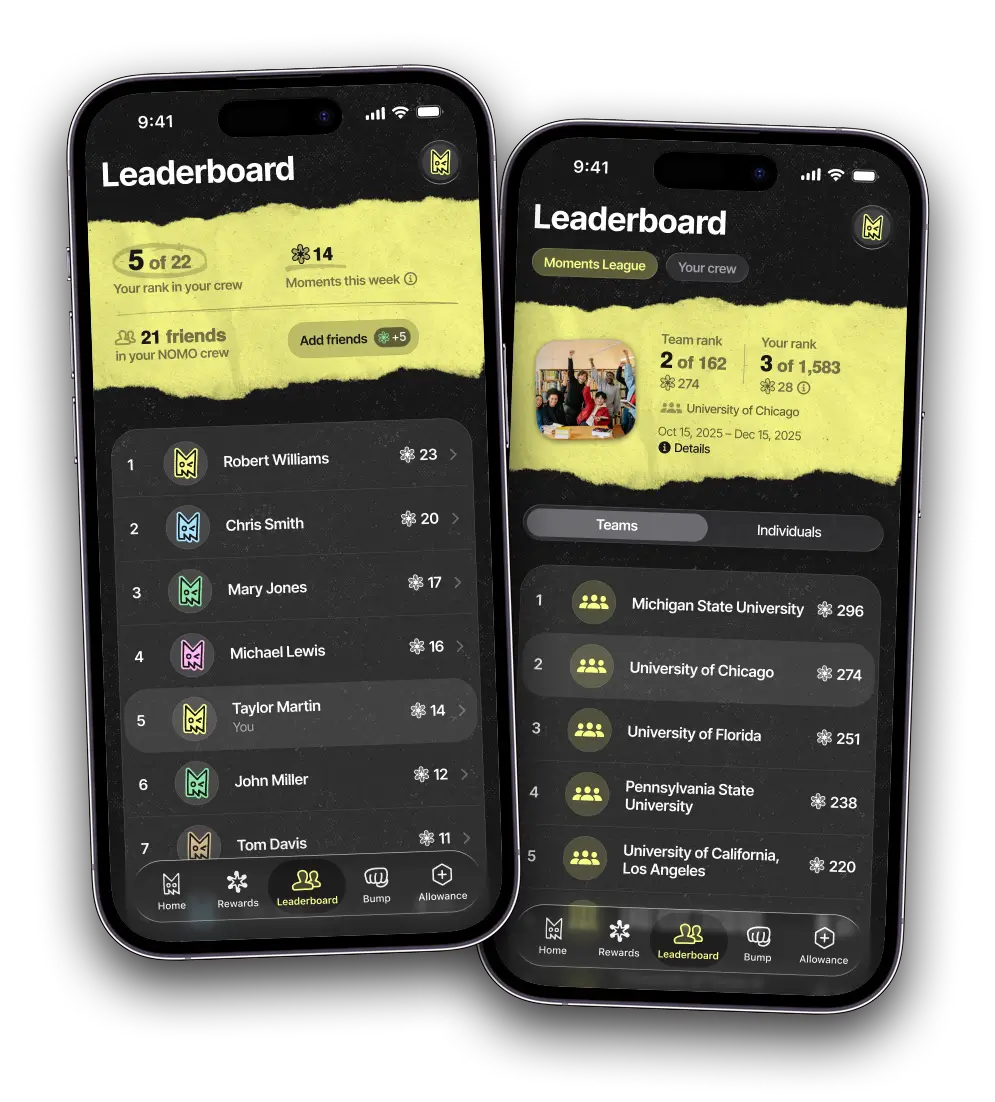
Friends compete for Moments, so status goes to time well spent instead of time online. The social energy that used to push teens onto the feed now pulls them away from it.
Friends compete for Moments, so status goes to time well spent instead of time online. The social energy that used to push teens onto the feed now pulls them away from it.

Incentives
Real Rewards
Real Rewards
Less scrolling earns more Moments, and teens redeem them for rewards and experiences. The incentive gets the first movers going and helps the group reach a tipping point.
Less scrolling earns more Moments, and teens redeem them for rewards and experiences. The incentive gets the first movers going and helps the group reach a tipping point.
Alternatives
Things to do instead
Things to do instead
NOMO suggests things to do in real time, and many rewards are themselves something to do. The reclaimed time goes back into real life.
NOMO suggests things to do in real time, and many rewards are themselves something to do. The reclaimed time goes back into real life.

That's the theory. Here's what happened when teens used it.
That's the theory. Here's what happened when teens used it.
The University of Chicago Study
The University of Chicago Study
United States • Oct 2024
United States • Oct 2024
A pilot experiment was implemented at the University of Chicago with 808 participants. The primary goal was to curb student usage of Instagram and TikTok by imposing a combined daily usage cap of 60 minutes, for two weeks.
A pilot experiment was implemented at the University of Chicago with 808 participants. The primary goal was to curb student usage of Instagram and TikTok by imposing a combined daily usage cap of 60 minutes, for two weeks.
Challenge participants substantially reduced their daily usage of TikTok and Instagram by 30.6 minutes or around 50%. After completing the two-week long NOMO challenge, the incidence of feeling depressed nearly halved, dropping from 38.7% to 20.7%. Reports of anxiety also eased, and the share of participants who felt easily distracted fell from 47.9% to 36.8%. At the same time, life‐satisfaction incidence climbed from 61.1% to 70.6%.
Challenge participants substantially reduced their daily usage of TikTok and Instagram by 30.6 minutes or around 50%. After completing the two-week long NOMO challenge, the incidence of feeling depressed nearly halved, dropping from 38.7% to 20.7%. Reports of anxiety also eased, and the share of participants who felt easily distracted fell from 47.9% to 36.8%. At the same time, life‐satisfaction incidence climbed from 61.1% to 70.6%.
Together, these shifts suggest that reducing social media helped participants feel healthier, happier, and more satisfied with their daily lives.
Together, these shifts suggest that reducing social media helped participants feel healthier, happier, and more satisfied with their daily lives.
50%
Less time on
social media
Less time on
social media


47%
Drop in reported
depression symptoms

16%
Rise in reported
life satisfaction
Mental health improvements from 2-week NOMO challenge at UChicago
Mental health improvements from 2-week NOMO challenge at UChicago
Fall 2024 • Compared with a regular week, in the last two weeks.
← Swipe to view more →
Inspiring behavior change through collective action in 13-15 year olds
Inspiring behavior change through collective action in 13-15 year olds
United Kingdom • Nov 2025 – May 2026
United Kingdom • Nov 2025 – May 2026
UK Schools: Social media use drops with NOMO
7-day average of the daily mean, among engaged users
Mean across engaged students (a streak event within ±3 days), 16 Apr-18 May 2026.
With NOMO = first-wave students' active days; Before NOMO = second-wave students' week before joining.
Excludes failed 0-minute readings and pre-NOMO days more than a week before signup. Days with fewer than 5 students are interpolated.
NOMO at scale in Rio de Janeiro
NOMO at scale in Rio de Janeiro
Brazil • May 2026 – Ongoing
Brazil • May 2026 – Ongoing
When a whole school joins together, most students take part, and the social pull starts working in the other direction.
When a whole school joins together, most students take part, and the social pull starts working in the other direction.
In partnership with the city of Rio de Janeiro, NOMO launched in municipal schools in 2026. The first 100 schools are live with 500 by the end of the year.
In partnership with the city of Rio de Janeiro, NOMO launched in municipal schools in 2026. The first 100 schools are live with 500 by the end of the year.
Student and teacher ambassadors introduced NOMO. Students competed for individual rewards like movie tickets and sneakers, and classrooms competed for collective rewards like field trips and museum visits. The result was 83% participation, while the average student spends less than two minutes a day in the NOMO app.
Student and teacher ambassadors introduced NOMO. Students competed for individual rewards like movie tickets and sneakers, and classrooms competed for collective rewards like field trips and museum visits. The result was 83% participation, while the average student spends less than two minutes a day in the NOMO app.
How the norm changed
How the norm changed
Two things spread on their own:
Two things spread on their own:
Bump went viral
Bump went viral
Locking apps together with a friend became a social ritual, and real-life popularity became the status that counted.
Locking apps together with a friend became a social ritual, and real-life popularity became the status that counted.
Classroom rewards created FOMO in the other direction
Classroom rewards created FOMO in the other direction
When one class earned a collective reward, other classrooms wanted in.
When one class earned a collective reward, other classrooms wanted in.
This is the tipping point that Australia's ban never reached. Instead of the popular kids staying on social media, logging off became the thing to be seen doing.
This is the tipping point that Australia's ban never reached. Instead of the popular kids staying on social media, logging off became the thing to be seen doing.
What students say
What students say
Three in-app surveys, with more than 1,000 responses from students in 100 schools:
Three in-app surveys, with more than 1,000 responses from students in 100 schools:
The collective effect:
The collective effect:
61% say it’s easier to use social media less because their friends are using it less too
74% say they use their time better
57% report fewer fights with classmates over things that happened on social media
61% say it’s easier to use social media less because their friends are using it less too
74% say they use their time better
57% report fewer fights with classmates over things that happened on social media
The verdict:
The verdict:
90% report a positive overall impact on their lives
86% want NOMO to continue at their school next year
85% would recommend it to a friend
90% report a positive overall impact on their lives
86% want NOMO to continue at their school next year
85% would recommend it to a friend
Where the time goes: 49% said they used the freed-up time to sleep
Where the time goes: 49% said they used the freed-up time to sleep
Partner with NOMO to help your community reach its tipping point
Partner with NOMO to help your community reach its tipping point
For state leaders, school districts, and public health officials, the NOMO behavioral scientists can walk you through the research and how a NOMO program works in practice. Submit the form above or email NOMO to request a briefing.
For state leaders, school districts, and public health officials, the NOMO behavioral scientists can walk you through the research and how a NOMO program works in practice. Submit the form above or email NOMO to request a briefing.
The behavioral scientists behind NOMO
The behavioral scientists behind NOMO
Leonardo Bursztyn
CEO & Founder
Leonardo (PhD, Harvard) is the Saieh Family Professor of Economics at the University of Chicago and leading expert in behavioral economics. He co-directs the Becker Friedman Institute’s Program in Behavioral Economics Research and leads the Normal Lab. His research shows how social environments shape economic and political decisions across the globe. He is one of the authors of the landmark study on the social media trap.
Angela Duckworth
Scientific Advisor
A MacArthur “Genius Grant” recipient, Rosa Lee and Egbert Chang Professor at UPenn, and bestselling author of Grit, Angela is a leading expert in behavior change and motivation, with a background in neuroscience, psychology, and education. She co-directs the Behavior Change for Good Initiative at Penn and has advised the World Bank, major sports leagues, and Fortune 500 CEOs.
Betsy Levy Paluck
Scientific Advisor
A MacArthur “Genius Grant” recipient and Eugene Higgins Professor of Psychology and Public Affairs at Princeton, Betsy pioneered large-scale field experiments to reduce prejudice, violence, and harmful social norms. Her work bridges social psychology with real-world impact. She is a global authority on evidence-based interventions for shifting behavior and norms at scale.
Matthew Gentzkow
Scientific Advisor
Recipient of the John Bates Clark Medal and Landau Professor of Technology and the Economy at Stanford, Matthew is a member of the National Academy of Sciences and a leading economist in media, technology, and behavior. His research explores the intersection of economics and social influence, with groundbreaking work on how information shapes decision-making and public attitudes.
Frequently asked questions
Frequently asked questions
Why can't teens quit social media?
Why can't teens quit social media?
Quitting alone costs them their social life. Plans, group chats, and status all run through the feed, so the teen who leaves first misses out. In the research, college students wanted $59 to quit TikTok alone for a month, but would pay $28 to have their classmates quit with them. The problem isn't willpower. It's a collective trap.
Quitting alone costs them their social life. Plans, group chats, and status all run through the feed, so the teen who leaves first misses out. In the research, college students wanted $59 to quit TikTok alone for a month, but would pay $28 to have their classmates quit with them. The problem isn't willpower. It's a collective trap.
Do social media bans work?
Do social media bans work?
Not on their own. After Australia banned under-16s in December 2025, researchers found that fewer than one in three banned 14 and 15 year olds were complying four months in. Two months later, it was closer to one in twenty. Teens said they'd follow the ban only if most of their friends did, and the popular kids kept using the apps.
Not on their own. After Australia banned under-16s in December 2025, researchers found that fewer than one in three banned 14 and 15 year olds were complying four months in. Two months later, it was closer to one in twenty. Teens said they'd follow the ban only if most of their friends did, and the popular kids kept using the apps.
What actually reduces teen social media use?
What actually reduces teen social media use?
Changing the group, not just the individual. The research points to three things: norms that make logging off the high-status move, incentives that reward less scrolling, and real alternatives for the reclaimed time. In NOMO trials, scroll time dropped by about half among University of Chicago students, average daily scroll time fell 40% in a randomized trial across 52 U.K. schools, and in Rio de Janeiro, schools rolled it out with student ambassadors and classroom competitions, 83% of students joined.
Changing the group, not just the individual. The research points to three things: norms that make logging off the high-status move, incentives that reward less scrolling, and real alternatives for the reclaimed time. In NOMO trials, scroll time dropped by about half among University of Chicago students, average daily scroll time fell 40% in a randomized trial across 52 U.K. schools, and in Rio de Janeiro, schools rolled it out with student ambassadors and classroom competitions, 83% of students joined.
How can parents get their kids off social media?
How can parents get their kids off social media?
Make it a group effort instead of a house rule. Coordinate with the parents of your child's friends so no one teen is the only one offline. Plan real activities that fill the time, reward progress rather than only restricting use, and let your teen take ownership of the goal. Tools like NOMO are built to turn that into something teens do together with their friends.
Make it a group effort instead of a house rule. Coordinate with the parents of your child's friends so no one teen is the only one offline. Plan real activities that fill the time, reward progress rather than only restricting use, and let your teen take ownership of the goal. Tools like NOMO are built to turn that into something teens do together with their friends.
What is the social media trap?
What is the social media trap?
The social media trap is when people keep using a platform they'd rather live without, because leaving alone means missing out. Leo Bursztyn's research found that 64% of active TikTok users and 48% of Instagram users believe they would be better off if the platform didn't exist.
The social media trap is when people keep using a platform they'd rather live without, because leaving alone means missing out. Leo Bursztyn's research found that 64% of active TikTok users and 48% of Instagram users believe they would be better off if the platform didn't exist.
What is NOMO?
What is NOMO?
Built by leading behavioral scientists, NOMO rewards teens for spending less time scrolling. Teens join challenges with friends, earn Moments, and trade them for real-life rewards and experiences.
Built by leading behavioral scientists, NOMO rewards teens for spending less time scrolling. Teens join challenges with friends, earn Moments, and trade them for real-life rewards and experiences.
How to get kids
off social media,
according to research
How to get kids
off social media,
according to research
Teens want less social media. They just won't quit alone. Studies and field trials from Chicago to London to Rio de Janeiro show how to change that.
Teens want less social media. They just won't quit alone. Studies and field trials from Chicago to London to Rio de Janeiro show how to change that.
Why do teens spend so much time on social media?
Why do teens spend so much time on social media?
Two forces keep teens scrolling. The apps are built to hold their attention, and everyone they know is on them.
Two forces keep teens scrolling. The apps are built to hold their attention, and everyone they know is on them.
The platforms are designed for it
The platforms are designed for it
Endless feeds, autoplay, and notifications all exist for one purpose: keeping users engaged as long as possible. Every design choice is tested and refined towards that goal.
Endless feeds, autoplay, and notifications all exist for one purpose: keeping users engaged as long as possible. Every design choice is tested and refined towards that goal.
The feed is where their friends are
The feed is where their friends are
Most solutions miss this second force. Social media is social. Plans, group chats, inside jokes, viral moments, and status all run through the feed, so logging off means missing out. A teen who quits alone doesn't just lose an app. They lose their place in the conversation.
Most solutions miss this second force. Social media is social. Plans, group chats, inside jokes, viral moments, and status all run through the feed, so logging off means missing out. A teen who quits alone doesn't just lose an app. They lose their place in the conversation.
Teens want less social media.
They just can't do it solo.
Teens want less social media.
They just can't do it solo.
Built on 15 years of behavioral science, Leonardo Bursztyn's research finds that many young people wish they spent less time scrolling. But nobody wants to be the only one who leaves. That's a collective trap, and getting out of it takes collective action.
Built on 15 years of behavioral science, Leonardo Bursztyn's research finds that many young people wish they spent less time scrolling. But nobody wants to be the only one who leaves. That's a collective trap, and getting out of it takes collective action.
The social media trap
The social media trap
Young people would want to be paid to quit social media alone, but they'd pay to have everyone quit together.
Young people would want to be paid to quit social media alone, but they'd pay to have everyone quit together.
$59
$59
What students wanted to be paid to quit TikTok alone for a month.
What students wanted to be paid to quit TikTok alone for a month.
$28
$28
What they'd pay to have their friends quit with them.
What they'd pay to have their friends quit with them.
Why? FOMO.
No one changes a norm alone
No one changes a norm alone
In an incentivized experiment with more than 1,000 U.S. college students, Bursztyn and his co-authors asked what it would take for students to quit TikTok or Instagram for a month. Quitting alone was a cost, and students wanted to be paid to do it. When the question changed to "What if your classmates quit too?", the answer flipped. Many students would pay to make that happen.
In an incentivized experiment with more than 1,000 U.S. college students, Bursztyn and his co-authors asked what it would take for students to quit TikTok or Instagram for a month. Quitting alone was a cost, and students wanted to be paid to do it. When the question changed to "What if your classmates quit too?", the answer flipped. Many students would pay to make that happen.
The reason was fear of missing out. For most users, the platform's value comes from the fact that everyone else is on it. The researchers found that 64% of active TikTok users and 48% of Instagram users felt they would be better off if the platform didn't exist at all.
They stay because leaving alone costs too much. That's the collective trap.
Bursztyn, Handel, Jiménez-Durán & Roth, "When Product Markets Become Collective Traps: The Case of Social Media," American Economic Review. Read the study →
Why social media bans fall short
Why social media bans fall short
Australia's under-16 ban shows why rules alone can't break the trap
Australia's under-16 ban shows why rules alone can't break the trap
When their friends don't comply, teens don't either, and compliance with Australia's ban collapsed within months.
When their friends don't comply, teens don't either, and compliance with Australia's ban collapsed within months.
In December 2025, Australia became the first country to ban under-16s from major social media platforms. Bursztyn and a team that included Angela Duckworth and Cass Sunstein surveyed Australian teens to see what happened.
In December 2025, Australia became the first country to ban under-16s from major social media platforms. Bursztyn and a team that included Angela Duckworth and Cass Sunstein surveyed Australian teens to see what happened.
Four months in, fewer than one in three banned 14 and 15 year olds were complying. Two months after that, compliance had fallen to about one in twenty. Over the same period, the share of banned teens still using social media rose from 64% to 92%.
Four months in, fewer than one in three banned 14 and 15 year olds were complying. Two months after that, compliance had fallen to about one in twenty. Over the same period, the share of banned teens still using social media rose from 64% to 92%.
↑ Share of banned 14–15 year olds in Australia, April vs. June 2026. Source: Bursztyn et al., 2026.
Why the ban failed
Why the ban failed
Social media is social
Social media is social
Most teens who kept using the apps gave social reasons, and most believed their friends were still on them. A ban only works if your peers follow it too.
Most teens who kept using the apps gave social reasons, and most believed their friends were still on them. A ban only works if your peers follow it too.
A tipping point is necessary
A tipping point is necessary
Teens said they'd comply once about two-thirds of their peers did. Compliance never got close, so it unraveled.
Teens said they'd comply once about two-thirds of their peers did. Compliance never got close, so it unraveled.
But it isn't enough
But it isn't enough
Teens who complied were seen as less popular. Until popular, influential kids get off too, leaving looks like losing status.
Teens who complied were seen as less popular. Until popular, influential kids get off too, leaving looks like losing status.
A ban changes the rules. It doesn't change why teens want to be there. That takes a different approach.
A ban changes the rules. It doesn't change why teens want to be there. That takes a different approach.
Bursztyn, Duckworth, Jiménez-Durán, Leonard, Milojević, Roth & Sunstein, "Tipping Points and Australia's Social Media Ban," NBER Working Paper 35162. Read the study →
Australia's own eSafety Commissioner reported 81% of under-16s were still using social media three months after the ban took effect.
Australia's own eSafety Commissioner reported 81% of under-16s were still using social media three months after the ban took effect.
What works to get kids off social media
What works to get kids off social media
To get kids off social media, you have to change what their friends do, not just what they're allowed to do. The research points to three things that get a group to a tipping point: new norms, real incentives, and something better to do with their time.
To get kids off social media, you have to change what their friends do, not just what they're allowed to do. The research points to three things that get a group to a tipping point: new norms, real incentives, and something better to do with their time.
Platform changes and bans deal with the supply side, meaning how the apps function and who's allowed on them and when. They don't touch the demand side: the social pull that makes teens want to be there, and makes them look for a workaround when they aren't allowed.
Platform changes and bans deal with the supply side, meaning how the apps function and who's allowed on them and when. They don't touch the demand side: the social pull that makes teens want to be there, and makes them look for a workaround when they aren't allowed.
Teens log off for good when enough of their friends do too.
Teens log off for good when enough of their friends do too.
Norms
Make logging off the high-status move
Teens follow what the influential kids do, so the goal is to make time off the feed the thing to be seen doing. Autonomy matters too so it has to feel like their choice, not something forced upon them. A similar shift in norms helped drive down youth smoking.
Incentives
Reward people for scrolling less
Leaving a platform alone has a real social cost. Incentives offset it, and they get the first wave of kids moving before the new norm can take hold.
Alternatives
Offer something to do with reclaimed time
Hours taken away from scrolling have to go somewhere. The best alternative is friends, but friends are only available if they aren't scrolling either. That's why reducing screen use one teen at a time doesn’t work.
Norms
Make logging off the high-status move
Teens follow what the influential kids do, so the goal is to make time off the feed the thing to be seen doing. Autonomy matters too so it has to feel like their choice, not something forced upon them. A similar shift in norms helped drive down youth smoking.
Incentives
Reward people for scrolling less
Leaving a platform alone has a real social cost. Incentives offset it, and they get the first wave of kids moving before the new norm can take hold.
Alternatives
Offer something to do with reclaimed time
Hours taken away from scrolling have to go somewhere. The best alternative is friends, but friends are only available if they aren't scrolling either. That's why reducing screen use one teen at a time doesn’t work.
Put into action together, these principles are effective as a group activity, not as an exercise in personal willpower. That's what NOMO was built for.
Put into action together, these principles are effective as a group activity, not as an exercise in personal willpower. That's what NOMO was built for.
How NOMO puts the research to work
How NOMO puts the research to work
Built by leading behavioral scientists, NOMO is designed to change a collective habit, not just an individual one.
Built by leading behavioral scientists, NOMO is designed to change a collective habit, not just an individual one.
Leonardo Bursztyn
CEO & Founder
Angela Duckworth
Scientific Advisor
Betsy Levy Paluck
Scientific Advisor
Matthew Gentzkow
Scientific Advisor
Leonardo Bursztyn
CEO & Founder
Angela Duckworth
Scientific Advisor
Betsy Levy Paluck
Scientific Advisor
Matthew Gentzkow
Scientific Advisor
NOMO uses the science of collective action and incentives to help people reclaim their time. People give so much of their time to social media because everyone else does, so change has to happen together. NOMO moves whole groups toward a healthier balance with real life, and brand partners reward them for it.
NOMO uses the science of collective action and incentives to help people reclaim their time. People give so much of their time to social media because everyone else does, so change has to happen together. NOMO moves whole groups toward a healthier balance with real life, and brand partners reward them for it.
Collective action
Challenges & Bumps
Challenges & Bumps
Teens join challenges with friends and bump phones to lock their scrolling apps while together, earning extra Moments when they do. Nobody logs off alone.
Teens join challenges with friends and bump phones to lock their scrolling apps while together, earning extra Moments when they do. Nobody logs off alone.
Norms
Leaderboard
Leaderboard
Friends compete for Moments, so status goes to time well spent instead of time online. The social energy that used to push teens onto the feed now pulls them away from it.
Friends compete for Moments, so status goes to time well spent instead of time online. The social energy that used to push teens onto the feed now pulls them away from it.
Incentives
Real Rewards
Real Rewards
Less scrolling earns more Moments, and teens redeem them for rewards and experiences. The incentive gets the first movers going and helps the group reach a tipping point.
Less scrolling earns more Moments, and teens redeem them for rewards and experiences. The incentive gets the first movers going and helps the group reach a tipping point.
Alternatives
Things to do instead
Things to do instead
NOMO suggests things to do in real time, and many rewards are themselves something to do. The reclaimed time goes back into real life.
NOMO suggests things to do in real time, and many rewards are themselves something to do. The reclaimed time goes back into real life.
That's the theory. Here's what happened when teens used it.
That's the theory. Here's what happened when teens used it.
The University of Chicago Study
The University of Chicago Study
United States • Oct 2024
United States • Oct 2024
A pilot experiment was implemented at the University of Chicago with 808 participants. The primary goal was to curb student usage of Instagram and TikTok by imposing a combined daily usage cap of 60 minutes, for two weeks.
A pilot experiment was implemented at the University of Chicago with 808 participants. The primary goal was to curb student usage of Instagram and TikTok by imposing a combined daily usage cap of 60 minutes, for two weeks.
Challenge participants substantially reduced their daily usage of TikTok and Instagram by 30.6 minutes or around 50%. After completing the two-week long NOMO challenge, the incidence of feeling depressed nearly halved, dropping from 38.7% to 20.7%. Reports of anxiety also eased, and the share of participants who felt easily distracted fell from 47.9% to 36.8%. At the same time, life‐satisfaction incidence climbed from 61.1% to 70.6%.
Challenge participants substantially reduced their daily usage of TikTok and Instagram by 30.6 minutes or around 50%. After completing the two-week long NOMO challenge, the incidence of feeling depressed nearly halved, dropping from 38.7% to 20.7%. Reports of anxiety also eased, and the share of participants who felt easily distracted fell from 47.9% to 36.8%. At the same time, life‐satisfaction incidence climbed from 61.1% to 70.6%.
Together, these shifts suggest that reducing social media helped participants feel healthier, happier, and more satisfied with their daily lives.
Together, these shifts suggest that reducing social media helped participants feel healthier, happier, and more satisfied with their daily lives.
50%
Less time on
social media
Less time on
social media
47%
Drop in reported
depression symptoms
16%
Rise in reported
life satisfaction
Mental health improvements from 2-week NOMO challenge at UChicago
Mental health improvements from 2-week NOMO challenge at UChicago
Fall 2024 • Compared with a regular week, in the last two weeks.
← Swipe to view more →
Inspiring behavior change through collective action in 13-15 year olds
Inspiring behavior change through collective action in 13-15 year olds
United Kingdom • Nov 2025 – May 2026
United Kingdom • Nov 2025 – May 2026
UK Schools: Social media use drops with NOMO
7-day average of the daily mean, among engaged users
Mean across engaged students (a streak event within ±3 days), 16 Apr-18 May 2026.
With NOMO = first-wave students' active days; Before NOMO = second-wave students' week before joining.
Excludes failed 0-minute readings and pre-NOMO days more than a week before signup. Days with fewer than 5 students are interpolated.
NOMO at scale in Rio de Janeiro
NOMO at scale in Rio de Janeiro
Brazil • May 2026 – Ongoing
Brazil • May 2026 – Ongoing
When a whole school joins together, most students take part, and the social pull starts working in the other direction.
When a whole school joins together, most students take part, and the social pull starts working in the other direction.
In partnership with the city of Rio de Janeiro, NOMO launched in municipal schools in 2026. The first 100 schools are live with 500 by the end of the year.
In partnership with the city of Rio de Janeiro, NOMO launched in municipal schools in 2026. The first 100 schools are live with 500 by the end of the year.
Student and teacher ambassadors introduced NOMO. Students competed for individual rewards like movie tickets and sneakers, and classrooms competed for collective rewards like field trips and museum visits. The result was 83% participation, while the average student spends less than two minutes a day in the NOMO app.
Student and teacher ambassadors introduced NOMO. Students competed for individual rewards like movie tickets and sneakers, and classrooms competed for collective rewards like field trips and museum visits. The result was 83% participation, while the average student spends less than two minutes a day in the NOMO app.
How the norm changed
How the norm changed
Two things spread on their own:
Two things spread on their own:
Bump went viral
Bump went viral
Locking apps together with a friend became a social ritual, and real-life popularity became the status that counted.
Locking apps together with a friend became a social ritual, and real-life popularity became the status that counted.
Classroom rewards created FOMO in the other direction
Classroom rewards created FOMO in the other direction
When one class earned a collective reward, other classrooms wanted in.
When one class earned a collective reward, other classrooms wanted in.
This is the tipping point that Australia's ban never reached. Instead of the popular kids staying on social media, logging off became the thing to be seen doing.
This is the tipping point that Australia's ban never reached. Instead of the popular kids staying on social media, logging off became the thing to be seen doing.
What students say
What students say
Three in-app surveys, with more than 1,000 responses from students in 100 schools:
Three in-app surveys, with more than 1,000 responses from students in 100 schools:
The collective effect:
The collective effect:
61% say it’s easier to use social media less because their friends are using it less too
74% say they use their time better
57% report fewer fights with classmates over things that happened on social media
61% say it’s easier to use social media less because their friends are using it less too
74% say they use their time better
57% report fewer fights with classmates over things that happened on social media
The verdict:
The verdict:
90% report a positive overall impact on their lives
86% want NOMO to continue at their school next year
85% would recommend it to a friend
90% report a positive overall impact on their lives
86% want NOMO to continue at their school next year
85% would recommend it to a friend
Where the time goes: 49% said they used the freed-up time to sleep
Where the time goes: 49% said they used the freed-up time to sleep
Partner with NOMO to help your community reach its tipping point
Partner with NOMO to help your community reach its tipping point
For state leaders, school districts, and public health officials, the NOMO behavioral scientists can walk you through the research and how a NOMO program works in practice. Submit the form above or email NOMO to request a briefing.
For state leaders, school districts, and public health officials, the NOMO behavioral scientists can walk you through the research and how a NOMO program works in practice. Submit the form above or email NOMO to request a briefing.
The behavioral scientists behind NOMO
The behavioral scientists behind NOMO
Leonardo Bursztyn
CEO & Founder
Leonardo (PhD, Harvard) is the Saieh Family Professor of Economics at the University of Chicago and leading expert in behavioral economics. He co-directs the Becker Friedman Institute’s Program in Behavioral Economics Research and leads the Normal Lab. His research shows how social environments shape economic and political decisions across the globe. He is one of the authors of the landmark study on the social media trap.
Angela Duckworth
Scientific Advisor
A MacArthur “Genius Grant” recipient, Rosa Lee and Egbert Chang Professor at UPenn, and bestselling author of Grit, Angela is a leading expert in behavior change and motivation, with a background in neuroscience, psychology, and education. She co-directs the Behavior Change for Good Initiative at Penn and has advised the World Bank, major sports leagues, and Fortune 500 CEOs.
Betsy Levy Paluck
Scientific Advisor
A MacArthur “Genius Grant” recipient and Eugene Higgins Professor of Psychology and Public Affairs at Princeton, Betsy pioneered large-scale field experiments to reduce prejudice, violence, and harmful social norms. Her work bridges social psychology with real-world impact. She is a global authority on evidence-based interventions for shifting behavior and norms at scale.
Matthew Gentzkow
Scientific Advisor
Recipient of the John Bates Clark Medal and Landau Professor of Technology and the Economy at Stanford, Matthew is a member of the National Academy of Sciences and a leading economist in media, technology, and behavior. His research explores the intersection of economics and social influence, with groundbreaking work on how information shapes decision-making and public attitudes.
Leonardo Bursztyn
CEO & Founder
Leonardo (PhD, Harvard) is the Saieh Family Professor of Economics at the University of Chicago and leading expert in behavioral economics. He co-directs the Becker Friedman Institute’s Program in Behavioral Economics Research and leads the Normal Lab. His research shows how social environments shape economic and political decisions across the globe. He is one of the authors of the landmark study on the social media trap.
Angela Duckworth
Scientific Advisor
A MacArthur “Genius Grant” recipient, Rosa Lee and Egbert Chang Professor at UPenn, and bestselling author of Grit, Angela is a leading expert in behavior change and motivation, with a background in neuroscience, psychology, and education. She co-directs the Behavior Change for Good Initiative at Penn and has advised the World Bank, major sports leagues, and Fortune 500 CEOs.
Betsy Levy Paluck
Scientific Advisor
A MacArthur “Genius Grant” recipient and Eugene Higgins Professor of Psychology and Public Affairs at Princeton, Betsy pioneered large-scale field experiments to reduce prejudice, violence, and harmful social norms. Her work bridges social psychology with real-world impact. She is a global authority on evidence-based interventions for shifting behavior and norms at scale.
Matthew Gentzkow
Scientific Advisor
Recipient of the John Bates Clark Medal and Landau Professor of Technology and the Economy at Stanford, Matthew is a member of the National Academy of Sciences and a leading economist in media, technology, and behavior. His research explores the intersection of economics and social influence, with groundbreaking work on how information shapes decision-making and public attitudes.
Frequently asked questions
Frequently asked questions
Why can't teens quit social media?
Why can't teens quit social media?
Quitting alone costs them their social life. Plans, group chats, and status all run through the feed, so the teen who leaves first misses out. In the research, college students wanted $59 to quit TikTok alone for a month, but would pay $28 to have their classmates quit with them. The problem isn't willpower. It's a collective trap.
Quitting alone costs them their social life. Plans, group chats, and status all run through the feed, so the teen who leaves first misses out. In the research, college students wanted $59 to quit TikTok alone for a month, but would pay $28 to have their classmates quit with them. The problem isn't willpower. It's a collective trap.
Do social media bans work?
Do social media bans work?
Not on their own. After Australia banned under-16s in December 2025, researchers found that fewer than one in three banned 14 and 15 year olds were complying four months in. Two months later, it was closer to one in twenty. Teens said they'd follow the ban only if most of their friends did, and the popular kids kept using the apps.
Not on their own. After Australia banned under-16s in December 2025, researchers found that fewer than one in three banned 14 and 15 year olds were complying four months in. Two months later, it was closer to one in twenty. Teens said they'd follow the ban only if most of their friends did, and the popular kids kept using the apps.
What actually reduces teen social media use?
What actually reduces teen social media use?
Changing the group, not just the individual. The research points to three things: norms that make logging off the high-status move, incentives that reward less scrolling, and real alternatives for the reclaimed time. In NOMO trials, scroll time dropped by about half among University of Chicago students, average daily scroll time fell 40% in a randomized trial across 52 U.K. schools, and in Rio de Janeiro, schools rolled it out with student ambassadors and classroom competitions, 83% of students joined.
Changing the group, not just the individual. The research points to three things: norms that make logging off the high-status move, incentives that reward less scrolling, and real alternatives for the reclaimed time. In NOMO trials, scroll time dropped by about half among University of Chicago students, average daily scroll time fell 40% in a randomized trial across 52 U.K. schools, and in Rio de Janeiro, schools rolled it out with student ambassadors and classroom competitions, 83% of students joined.
How can parents get their kids off social media?
How can parents get their kids off social media?
Make it a group effort instead of a house rule. Coordinate with the parents of your child's friends so no one teen is the only one offline. Plan real activities that fill the time, reward progress rather than only restricting use, and let your teen take ownership of the goal. Tools like NOMO are built to turn that into something teens do together with their friends.
Make it a group effort instead of a house rule. Coordinate with the parents of your child's friends so no one teen is the only one offline. Plan real activities that fill the time, reward progress rather than only restricting use, and let your teen take ownership of the goal. Tools like NOMO are built to turn that into something teens do together with their friends.
What is the social media trap?
What is the social media trap?
The social media trap is when people keep using a platform they'd rather live without, because leaving alone means missing out. Leo Bursztyn's research found that 64% of active TikTok users and 48% of Instagram users believe they would be better off if the platform didn't exist.
The social media trap is when people keep using a platform they'd rather live without, because leaving alone means missing out. Leo Bursztyn's research found that 64% of active TikTok users and 48% of Instagram users believe they would be better off if the platform didn't exist.
What is NOMO?
What is NOMO?
Built by leading behavioral scientists, NOMO rewards teens for spending less time scrolling. Teens join challenges with friends, earn Moments, and trade them for real-life rewards and experiences.
Built by leading behavioral scientists, NOMO rewards teens for spending less time scrolling. Teens join challenges with friends, earn Moments, and trade them for real-life rewards and experiences.
$59
$59
What students wanted to be paid to quit TikTok alone for a month.
What students wanted to be paid to quit TikTok alone for a month.